Showing posts with label Austin Healey Cars. Show all posts

Sunday, February 13, 2011

Austin-Healey Sprite (Mark III, Mk III, MK3) Parts 2

Austin Healey Sprite

Austin-Healey Sprite (Mark III, Mk III) Parts 2


Austin-Healey Sprite (Mark III, Mk III, MK3) Parts 2 ~ Austin Healey Sprite
Picture Of

Austin Healey Sprite

Austin Healey Sprite

Austin-Healey Sprite (Mark III, Mk III) Parts 2

It has been suggested here that there was a "short run of vehicles (unknown number) in late 1963 with the Austin Healey Sprite Mk II body/interior but with the Austin Healey Sprite Mk III undercarriage/suspension modifications". Although no source is given for this assertion, the basis may be more than speculation. There are numerous recorded instances throughout Austin Healey Sprite and Midget production where specification changes do not precisely concur with model changes. At the very least, the prototypes for the half-elliptic models are likely to have been taken from the production line and some of these may well have been subsequently sold. However, the number of such cars would have been small.

(At least one such was exported to Italy, where it was still running until wrecked in 1971. It had the full MK III undercarriage and instrument cluster and front disc brakes, but Mk II coachwork.)

Engine:

* 1964–1966 - 1098 cc A-Series I4, 59 hp (44 kW) at 5750 rpm and 65 lbf?ft (88 Nm) at 3500 rpm

Related : Austin Healey Sprite
Related : Austin Healey Cars

Related : Austin-Healey Sprite ~ Austin-Healey Sprite (Mark III, Mk III, MK3) Parts 1

Related : Austin-Healey Sprite (Mark III, Mk III, MK3) Parts 2 From Wikipedia, the free encyclopedia, Austin Healey Sprite

Saturday, November 27, 2010

Austin-Healey Cars Models Austin-Healey Sprite (Mark II, Mk II) Parts 3

Austin-Healey Cars Models Austin-Healey Sprite (Mark II, Mk II) Parts 3


Austin-Healey Cars Models Austin-Healey Sprite (Mark II, Mk II)
Picture Of

Austin-Healey Cars


Austin-Healey Cars // Austin-Healey Sprite

Austin-Healey Sprite Parts 1

Production : 1961-1964, 31,665 made
Engine(s) : 948 cc later 1098 cc A-Series I4
Wheelbase : 2,032 mm (80.0 in)
Length : 3,305 mm (130.1 in)
Width : 1,346 mm (53.0 in)
Height : 48.25 in (1,226 mm) (with hood up)
Related : MG Midget MkI

Few cars have been more adroitly timed or more right for their time than the original Austin-Healey Sprite, the beloved “Bugeye.” It was conceived to fill an obvious market gap that existed by the time the genuinely small sporting MGs, the Midgets of the 1930s and 1940s, had evolved into the larger, costlier, more modern and “mature” MGA of the 1950s.

BMC chairman Sir Leonard Lord rarely missed a commercial trick, and invited the Healey family to design a small, back-to-basics sports car that would complement, rather than compete with, the popular MGA. As this collaboration had already led to the Austin-Healey 100, which was selling very well in the U.S., Lord was convinced that the new small Healey would have similar success. As it turned out, he was right.


Sunday, November 21, 2010

Used Austin-Healey Cars Models Austin-Healey Sprite (Mark II, Mk II) Parts 2

Used Austin-Healey Cars Models Austin-Healey Sprite (Mark II, Mk II) Parts 2


Austin-Healey Cars Models Austin-Healey Sprite
Picture Of

Austin-Healey Cars


Austin-Healey Cars // Austin-Healey Sprite

Austin-Healey Sprite Cars Parts 2

Innocenti also produced their own version of the Austin-Healey Sprite, using the standard production underframe (initially shipped out from England), but clothed in the sharpest of Italian suits, styled by the American Tom Tjaarda, then working at Carrozzeria Ghia. The Innocenti 950 Spider and later 1100 Spider were produced from 1961 until 1968.

A Cars with hardtop tested by the British magazine The Motor in 1961 had a top speed of 85.8 mph (138.1 km/h) and could accelerate from 0-60 mph (97 km/h) in 20.0 seconds. A fuel consumption of 43.5 miles per imperial gallon (6.49 L/100 km; 36.2 mpg-US) was recorded. The test Cars , which was to de-luxe specification cost £705 including taxes of £208.

Engines


* 1961–1964 - 948 cc A-Series I4, 46 hp (34 kW) at 5500 rpm and 53 lbf·ft (72 Nm) at 3000 rpm
* 1962–1964 - 1098 cc A-Series I4, 56 hp (42 kW) at 5500 rpm and 62 lbf·ft (84 Nm) at 3250 rpm


Wednesday, November 10, 2010

Used Austin-Healey Cars Sprite Models Austin-Healey (Mark I, Mk I) Parts 3

Used Austin-Healey Cars Sprite Models Austin-Healey (Mark I, Mk I) Parts 3


Austin-Healey Cars Sprite
Picture Of

Austin-Healey Cars


Austin-Healey Cars

Austin-Healey Cars Parts 1

Austin Healey Sprite : Frogeye 1960
Production : 1958-1961, 48,987 made
Engine(s) : 948 cc A-Series I4
Wheelbase : 2,032 mm (80.0 in)
Length : 3,480 mm (137.0 in)
Width : 1,346 mm (53.0 in)
Height : 47.25 in (1,200 mm) (with hood up)
Designer : Donald Healey


Thursday, November 4, 2010

Used Austin-Healey Cars Sprite Models Austin-Healey (Mark I, Mk I) Parts 2

Used Austin-Healey Cars Sprite Models Austin-Healey (Mark I, Mk I) Parts 2


Austin-Healey Cars Sprite
Picture Of

Austin-Healey Cars


Austin-Healey Cars

Austin-Healey Cars Parts 1

The Austin-healey cars Sprites's chassis design was the world's first volume-production sports car to use integrated construction, where the sheet metal body panels (apart from the bonnet) take many of the structural stresses. The two front 'chassis' legs which project forward from the passenger compartment, however, stop the shell being a full monocoque. The design is said to have been influenced by the Jaguar D-type.

Engine


* 1958–1961 - 948cc cc A-Series I4, 43 hp (32 kW) at 5200 rpm and 52 lbf?ft (71 Nm) at 3300 rpm

Austin-healey cars was tested by the British magazine The Motor in 1958. It had a top speed of 82.9 mph (133.4 km/h) and could accelerate from 0-60 mph (97 km/h) in 20.5 seconds. Fuel consumption of 43 miles per imperial gallon (6.6 L/100 km; 36 mpg-US) was recorded. The test Austin-healey cars cost ?678, including taxes of ?223.

The BMC Competition Department entered Austin-healey cars Sprites in major international races and rallies, their first major success coming when John Sprinzel and Willy Cave won their class on the 1958 Alpine Rally. Private competitors also competed with much success in Austin-healey cars Sprites . Because of its affordability and practicality, the Austin-healey cars Sprites was developed into a formidable competition Austin-healey cars, assuming many variants by John Sprinzel, Speedwell and WSM. The Sebring Sprite became the most iconic of the racing breed of Austin-healey cars Sprites. Many owners use their Austin-healey cars Sprites in competition today, fifty years after its introduction.


Thursday, October 21, 2010

Austin-Healey Sprite Cars (Mark I, Mk I)Parts 1

Austin-Healey Sprite Cars (Mark I, Mk I)Parts 1


Austin-Healey Sprite Cars (Mark I, Mk I)
Picture Of Austin Healey Sprite Car

Mark I

The little Sprite quickly became affectionately known as the 'Frogeye' in the UK and the 'Bugeye' in the US, because its headlights were prominently mounted on top of the bonnet, inboard of the front wings. The car's designers had intended that the headlights could be retracted, with the lenses facing skyward when not in use. A similar arrangement was used many years later with the Porsche 928. However, production cost-cutting by BMC led to the flip-up mechanism being deleted and so the headlights were simply fixed in a permanently upright position, giving the car its most distinctive feature.

The front sheet-metal assembly, including the bonnet and wings, was a one-piece unit, hinged from the back, that swung up to allow access to the engine compartment. The 43 bhp, 948 cc engine (coded 9CC) was derived from the Austin A35 & Morris Minor 1000 models, also BMC products, but upgraded with twin 1 1/8" inch SU carburettors. The rack and pinion steering and suspension were derived from the Morris Minor 1000. The front suspension was a coil spring and wishbone arrangement, with the arm of the Armstrong lever shock absorber serving as the top suspension link. The rear axle was both located and sprung by quarter-elliptic leaf springs, again with lever-arm shock absorbers. There were no exterior door handles, with the driver and passenger required to reach inside in order to open the door. There was also no boot lid, and access to the spare wheel and luggage compartment was achieved by tilting the seat-backs forward and reaching under the rear deck, a process likened to potholing by many owners.


Friday, June 18, 2010

Austin-Healey 3000 Car And The History Of It Parts 2

Austin-Healey 3000 Car And The History Of It Parts 2

Austin Healey CarsPicture Of Austin Healey 3000 Cars

The original Austin Healey 3000 Cars had a 2912 cc (nearly 3 litres) I6 engine, with twin SU carburetors and Girling front disc brakes. It was only referred to as the Mark I after the Mark II was released, previously only being known as the 3000. Wire wheels, overdrive gearbox, a laminated windscreen, a heater, an adjustable steering column, a detachable hard top and two tone paint were all available as options.

Austin Healey CarsPicture Of Austin Healey 3000 Cars

The original 3000 was built from March 1959 - March1961 and has model designation BT7 MkI (4 seat version) and BN7 MkI (2 seater).

Austin Healey CarsPicture Of Austin Healey 3000 Cars

13,650 were made (2,825 BN7 MkI, and 10,825 BT7 MkI).

Austin Healey CarsPicture Of Austin Healey 3000 Cars

A BT7 3000 with hardtop and overdrive tested by The Motor magazine in 1960 had a top speed of 115 mph (185 km/h) and could accelerate from 0-60 mph (97 km/h) in 11.7 seconds. A fuel consumption of 21.6 miles per imperial gallon (13.1 L/100 km; 18.0 mpg-US) was recorded. The test car cost £1326 including taxes.

Sunday, June 13, 2010

Austin-Healey 3000 Car And The History Of It Parts 1

Austin-Healey 3000 Car And The History Of It Part 1

Austin Healey CarsPicture Of Austin Healey 3000 Cars

Austin Healey 3000 Cars

* 1959 - 1961 BN7 Mark I (2 seat), BT7 Mark I (2+2 seats)
* 1961 - 1962 BN7 Mark II (2 seat), BT7 Mark II (2+2 seats), BJ7 Mark II (2 seat)
* 1962 - 1964 BJ7 Mark II (roll-up windows)
* 1964 - 1967 BJ8 Mark III

Austin Healey CarsPicture Of Austin Healey 3000 Cars

The Austin Healey 3000 Cars is a British sports car built from 1959 to 1967, and is the best known of the 'big' Healey models. The car's bodywork was made by Jensen Motors, and the vehicles were assembled at the BMC Abingdon works.

Austin Healey CarsPicture Of Austin Healey 3000 Cars

The 3000 was a successful car which won its class in many European rallies in its heyday - and is still used in competition by enthusiasts today.

Tuesday, June 8, 2010

Austin-Healey 100-Six (BN4 and BN6) Car

Austin-Healey 100-Six (BN4 and BN6) Car

Austin Healey CarsAustin-Healey 100-Six Cars

Production 1956-1959
14,436 produced
Assembly Abingdon, England
Longbridge, England
Successor Austin-Healey 3000
Engine(s) 2639 cc C-Series I6
Wheelbase 92 in (2,337 mm)
Length 157.5 in (4,001 mm)
Width 60 in (1,524 mm)
Height 50 in (1,270 mm)

Thursday, June 3, 2010

Austin-Healey 100 BN1 And BN2 Car

Austin-Healey 100 BN1 And BN2 Car

Austin Healey CarsAustin-Healey 100 BN1 And BN2 Cars

Production 1953-1956
14,634 produced
Assembly Longbridge, England
West Bromwich, England
Successor Austin-Healey 100-Six, series BN4
Engine(s) 2660 cc I4
Transmission(s) 3-speed (series BN1) or 4-speed (series BN2) manual

90 in (2,286 mm)
Length 151 in (3,835 mm)
Width 60 in (1,524 mm)
Height 49.25 in (1,251 mm)
Fuel capacity 12 imp gal (55 L; 14 US gal)


Monday, May 24, 2010

Austin-Healey 100-Six(BN4-BN6) Car And The History Of It Parts

Austin-Healey 100-Six(BN4-BN6) Car And The History Of It Parts

Austin Healay CarsPicture Of Austin Healay Cars

The Austin Healey final "100" models, 1956's "BN4" (2+2 seats) and 1958's "BN6" (2 seats) were six-cylinder 100-Six cars.

Austin Healay CarsPicture Of Austin Healay Cars

To make room for the occasional seats the wheelbase was increased by 2 in (50.8 mm). The bonnet had a built-in air scoop and the windscreen no longer could be folded down.

Austin Healay CarsPicture Of Austin Healay Cars

The cars used a tuned version of the BMC C-Series engine previously fitted to Austin Westminster which at first produced 102 bhp (76 kW) increasing to 117 bhp (87 kW) in 1957 by fitting a revised manifold and cylinder head. The overdrive unit became an option rather than a standard fitting.

Austin Healay CarsPicture Of Austin Healay Cars

In late 1957 production was transferred from Longbridge to the MG plant at Abingdon.

Austin Healay CarsPicture Of Austin Healay Cars

A 117 bhp (87 kW) BN6 was tested by The Motor magazine in 1959 had a top speed of 103.9 mph (167.2 km/h) and could accelerate from 0-60 mph (97 km/h) in 10.7 seconds. A fuel consumption of 20.8 miles per imperial gallon (13.6 L/100 km; 17.3 mpg-US) was recorded. The test car cost £1307 including taxes of £436.


Wednesday, May 19, 2010

Austin-Healey 100(BN1, BN2) Car And The History Of It The End Parts

Austin-Healey 100(BN1, BN2) Car And The History Of It The End Parts

Austin Healay 100 Cars
Picture Of Austin Healay 100 Cars

The BN2 came with a real 4-speed manual transmission, still with overdrive on the top 2 gears. Other features that distinguish the BN2 from the BN1 are the slightly larger front wheel arches, different rear axle and being the first 100 with optional two-tone paint. The colour alternatives available to the 100 were: Reno Red, Spruce Green, Healey Blue, Florida Green, Old English White, Primrose Yellow, Black, and approximately 50 Gunmetal Grey cars. The BN2 two-tone colors were: White/Black; Reno Red/Black; Healey Blue/White; Black/Reno Red; and Florida Green/White. A 1956 BN2 100M (for Le Mans) model was developed as well, with larger carburettors, a cold air box to increase air flow to the carburettors, high-lift camshaft and 8.1:1 high compression pistons producing 110 bhp (82 kW) at 4500 rpm. The front suspension was stiffened and the bonnet gained louvres, along with a bonnet belt and most (approximately 70%) of them were finished with a two-tone paint scheme including two cars finished in unique color schemes: one White over Red and the other (for display at the 1955 London Motor Show) in Black over Pink. There were 640 factory built 100Ms -- all 1956 model BN2s. The 100M components (except for the high compression pistons) were also available as a Le Mans kit which could be installed in either a BN1 or BN2 with the engine in situ, improving the power output to 100 bhp (75 kW) at 4500 rpm. The Donald Healey Motor Company at Warwick retrofitted 519 cars with the Le Mans kit after they had been delivered to the original owners. The Le Mans kit and its component parts could be ordered from BMC, so additional cars were modified by Austin dealers and private owners.


Austin Healay 100 Cars
Picture Of 1957 Austin Healay 100 Cars

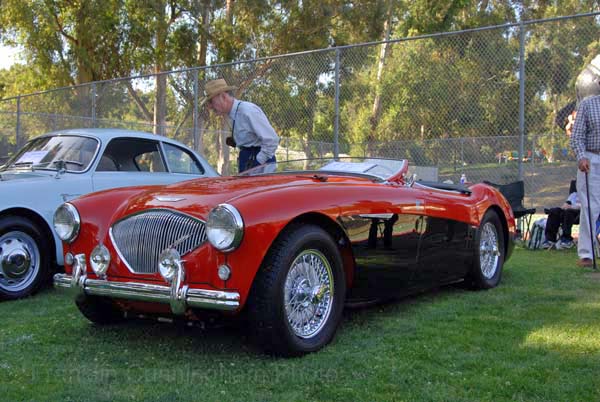
Built primarily with racing in mind, the aluminium-bodied "100S" (for Sebring) model developed 132 bhp (98 kW) at 4700 rpm. Only 50 production cars were produced, plus an additional five works development/special test cars which were hand built by the Donald Healey Motor Company at Warwick. The cast iron cylinder head was replaced by one made from aluminium and the overdrive unit was not fitted to the gearbox. Dunlop disc brakes were fitted front and rear. To keep weight to a minimum there were no bumpers or hood (convertible top), a smaller grille and the windscreen was plastic. The 100S was also the first production car in the world to sport disc brakes at both the front and rear. The car was approximately 200 lb (91 kg) lighter than standard. The majority of all 100S were two-toned White with Lobelia Blue sides. However, a handful of cars where ordered in Spruce Green, Reno Red and one single black 100S.

Austin Healay 100 CarsPicture Of 1958 Austin Healay 100 Cars

The final BN2 was produced in July 1956.

Friday, May 14, 2010

Austin-Healey 100(BN1, BN2) Car And The History Of It Parts 2

Austin-Healey 100(BN1, BN2) Car And The History Of It Parts 2

BN2 Austin Healey 100Picture Of 1956 Austin Healay 100 Cars

Production Austin Healey 100s Cars were finished at Austin's Longbridge plant alongside the A90 and based on fully trimmed and painted body/chassis units produced by Jensen in West Bromwich — in an arrangement the two companies previously had explored with the Austin A40 Sports. The first 100s (series "BN1") were equipped with the same 90 bhp (67 kW) engines and manual transmission as the stock A90, but the transmission was modified to be a three-speed unit with overdrive on second and top. The 2660 cc I4 engine featured an undersquare 87.3 mm (3.4 in) bore and 111.1 mm (4.4 in) stroke.

BN1 Austin Healey 100Picture Of Austin Healay 100M Cars

Girling 11 in (279.4 mm) drum brakes are fitted all round. Front suspension is independent using coil springs and at the rear is a rigid axle with semi elliptic leaf springs. The steering is by a cam and lever system.

BN2 Austin-Healey 100Picture Of 1956 Austin Healay 100 Cars

A BN1 tested by The Motor magazine in 1953 had a top speed of 106 mph (171 km/h) and could accelerate from 0-60 mph (97 km/h) in 11.2 seconds. A fuel consumption of 22.5 miles per imperial gallon (12.6 L/100 km; 18.7 mpg-US) was recorded. The test car cost £1063 including taxes.

BN1 Austin-Healey 100Picture Of 1954 Austin Healay 100 Cars

These were built from May 1953, and replaced by the BN2 model in mid-1955.


Tuesday, May 4, 2010

Austin-Healey Car And The History Of It The End Parts

Austin-Healey Car And The History Of It The End Parts

Austin Healey CarsPicture Of Austin Healay Cars

The joint venture dissolved in 1971 as the 20-year agreement came to an end. Final production of Austin Healey cars were marketed under the brand name Austin. A successful racing history, including Le Mans, Bathusrt and Sebring, gave Ausin Healey an almost legendary status.

Collector's Information

Austin-Healey-CarsPicture Of 1955 Austin Healay 100 Cars

There were many Austin Healey's produced, with later versions, such as MkIII and MkIV, being produced in larger numbers. As a result, parts aren't hard to find. Restoring an Austin Healey will result in a car with both high collector value and high financial value. Austin Healeys are beautifully designed and fun to drive. For their time, they were among the top performers in their respective classes, with the 3000 doing very well in a number of popular period road races.


Tuesday, April 27, 2010

Austin-Healey Car And The History Of It Parts 1

Austin-Healey Car And The History Of It Parts 1


Austin-Healey-Cars picture Austin Healey

Austin Healey was a British sports car maker. The marque was established through a joint venture arrangement, set up in 1952 between Leonard Lord of the Austin division of the British Motor Corporation (BMC) and Donald Healey, a renowned automotive engineer and designer.


Austin-Healey-Cars 100Picture Austin Healey 100

In the early 1950s, Donald Healey was hand-manufacturing a few cars in a small workshop. He showed a car, called the Healey 100, at the Earl's Court Motor Show, where it was seen by Leonard Lord, head of British Motor Corporation's Austin division. When he saw how well the Healey 100 was liked by the public, he approached Healey with a proposal for Austin to manufacture the car in larger quantities. The result was the Austin Healey 100.


Austin-Healey-Cars-100 Picture Austin Healey 100

With the introduction of the Austin Healey 100, the joint venture was off to a good start. The original design was manufactured from 1953 to 1955. In 1955, minor cosmetic and performance changes were made to the original 100. 1956 and 1957 saw some other cosmetic changes, including the conversion to a 2+2 seating configuration and a change to a larger carburetor. 1958 saw the introduction of a six-cylinder Austin Healey 100.


Austin-Healey-Cars 3000Picture Austin Healey 3000

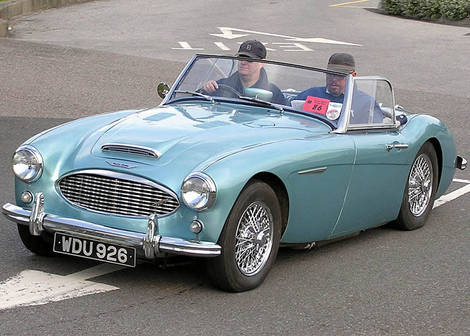
The first Austin Healey 3000 was built in 1959. Although it was a four-seater stock, it could be bought as a two-seater as well. It sported a 2912cc six-cylinder engine, and came with an overdrive gearbox and innovative front disc brakes. The Healey 3000 had a top speed of around 115 mph and could reach 60 mph in 11.7 seconds. Because it was so lightweight, it got 21.6 miles per gallon of fuel.


Austin-Healey-Cars-3000Picture Austin Healey 3000

The 1950s also saw a down-market version of the MG Midget, introduced as the Austin Healey Sprite. This small car was very simple, not terribly fast, but fun and very easy to maintain.

 
Austin-Healey Sprite